
In the cultural imagination, dystopias usually look dramatic: towering authoritarian cities, ruined landscapes, or governments collapsing under the weight of their own brutality. Yet one of the most unsettling warnings about dystopia comes not from a bleak sci-fi world, but from the bright, pastel-coloured streets of Seahaven in Peter Weir’s The Truman Show. The film imagines a society where surveillance doesn’t feel like surveillance, where control is disguised as comfort, and where the most dangerous prisons are the ones we mistake for home.
Released in 1998 long before social media, influencer culture, or 24/7 livestreaming, The Truman Show feels strangely prophetic today. Its central conceit is simple: Truman Burbank has lived his entire life inside a giant TV set, broadcast to millions without his consent. His world is perfectly designed, meticulously controlled, and always watching. But what makes the film so culturally significant is not its premise alone; it’s the way it exposes how easily a dystopia can be built out of familiar desires: safety, routine, entertainment, and the illusion of choice.
A Dystopia Without Violence
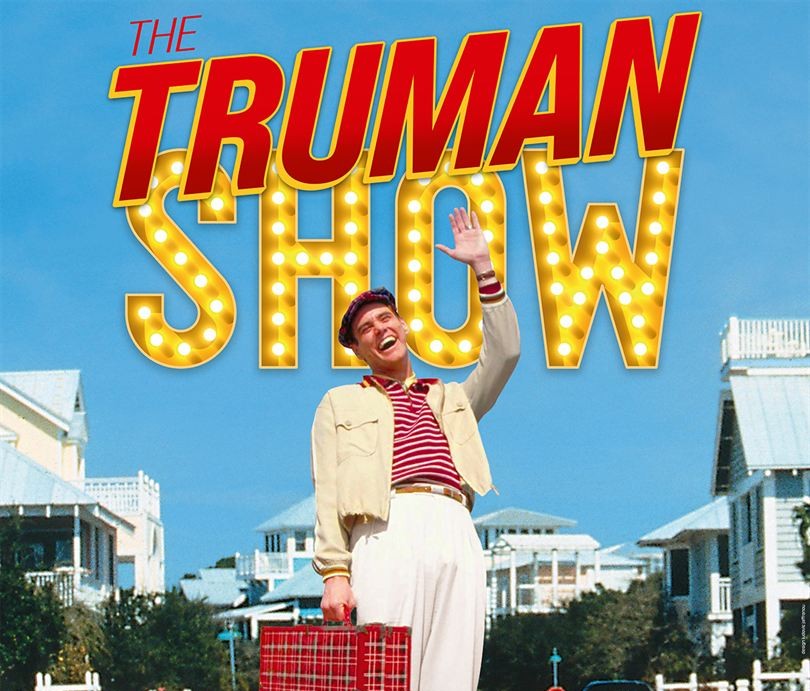
Unlike classic dystopias such as 1984 or Fahrenheit 451, the world of The Truman Show is friendly, colourful, and relentlessly polite. The danger doesn’t come from brutality but from subtle manipulation. Seahaven is engineered to keep Truman content enough that he won’t ask questions. Every smile from the townspeople, every advertisement woven into casual conversation, every perfectly predictable day, these are tools of control disguised as normality.
This is perhaps the film’s most chilling warning: dystopias do not need to be violent to be effective.
They only need to be convincing.
The Illusion of Freedom
Truman’s life looks “free” from the outside. He has a job, a house, friends, and a loving wife. Yet every decision he makes has already been planned for him ; routes he walks, fears he holds, even the people he trusts. Weir builds a world where the boundaries of a person’s reality are invisible, reaffirming the film’s central question: how would you recognise a cage if you were taught to love it?
In our contemporary moment, this question feels almost uncomfortably relevant. We curate our identities online, perform happiness for invisible audiences, and allow algorithms to shape what we see, what we desire, and sometimes even what we believe. We are not forced to participate; we are encouraged. And that’s precisely what makes the trap so effective.
Media as a Soft Dictatorship
Christof, the omniscient creator of the show, claims to love Truman. He insists the artificial world he built is safer and “better” than reality. His justification reveals another dystopian warning:
control becomes most dangerous when the oppressor believes he is doing the right thing.
The film anticipates modern debates about privacy, data collection, reality TV, and digital autonomy. It exposes how entertainment can become surveillance, how spectatorship can become complicity, and how the line between public and private life can dissolve without anyone noticing.
Weir seems to argue that a society obsessed with spectacle will inevitably turn people into products, willingly or not.
The Break in the Sky
The most famous moment in the film: Truman’s boat piercing the painted horizon, acts as a powerful metaphor for breaking through illusion. The wall he touches is not just the boundary of a set; it is the boundary of a mindset, a worldview built for him rather than by him.
The film suggests that dystopia ends not through revolt, but through recognition.
When Truman bows and steps through the exit door, it becomes one of cinema’s most quietly radical gestures: a man choosing uncertainty over controlled comfort, truth over spectacle, freedom over safety.
Why This Warning Matters Now
Today’s world increasingly resembles The Truman Show in unexpected ways. We are watched more than ever: by cameras, by platforms, by each other. Our lives are shaped by curated feeds, targeted ads, and invisible algorithms that anticipate our behaviour. We perform ourselves constantly, sometimes forgetting what is real and what is performed.
The film’s relevance comes from this eerie familiarity. It warns us that:
- a dystopia can feel pleasant
- surveillance can look like convenience
- control can be sold as comfort
- and the loss of autonomy can happen quietly, with a smile
What Weir ultimately argues is that the greatest threat to freedom is not oppression, it is complacency.
Conclusion: The Dystopia We Don’t See
The Truman Show endures because it reframes dystopia as something charming, peaceful, and dangerously ordinary. It forces us to ask whether our own realities are as “real” as we think, and whether the things that entertain us also control us.
The film’s final message is not pessimistic, but empowering: breaking the illusion begins with awareness. In a world increasingly structured by images, narratives, and curated realities, Truman’s step through the exit door feels less like fiction and more like an invitation.
An invitation to look up, question the sky, and make sure it isn’t painted.
Image source: https://www.la-comete.fr/programmation/cinema/the-truman-show

- More than Sound: Listening to What Makes Us Human - January 23, 2026
- When Justice Stops Feeling Abstract - January 10, 2026
- How Chips Quietly Shape Power - January 3, 2026