

Although Taiwan’s laws recognize Indigenous peoples’ rights, their limited implementation and unequal recognition reveal how legal justice can exist on paper but not in reality.
I walk through a Taiwanese mountain village where the signs are in Mandarin, not the tribe’s own language. I ask myself where we really came from. As a teenager living in Taiwan, I realize how little I’ve been taught about this subject. Taiwan’s laws say Indigenous people are recognized, but recognition without true equality is only a promise waiting to be fulfilled.
Learning about these issues has made me feel both grateful and unsettled, grateful to live in a country that values democracy, yet aware that I’ve only recently begun to understand the people who were here long before us. As a student, I believe recognizing Indigenous history is not just about the past; it’s about building a fairer Taiwan for the future.
Taiwan’s Indigenous Peoples Basic Law, enacted in 2005 and last amended in 2018, was designed to protect the rights, culture, and autonomy of Indigenous communities. It promises equal status, land and resource rights, self-governance, and respect for traditional practices. On paper, it sounds progressive, guaranteeing everything from language preservation to participation in lawmaking. But in practice, many of these promises remain only partially realized.
Starting with land rights and cultural freedom: traditional territories remain largely under government control, covering less than one-third of claimed lands. We forget that we have this island because of them. Their roots made our country possible, yet we discriminate against them and make them feel unwelcome and inferior. We take over their spaces and shame their traditions.
The Case of Tama Talum
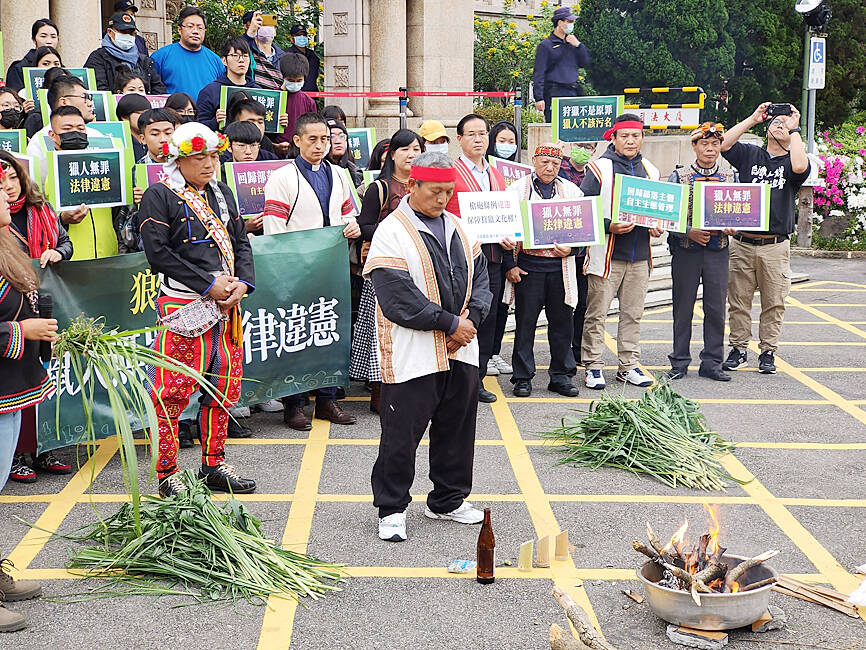
Photo: Wu Cheng-feng, Taipei Times
For instance, in 2015, a Bunun hunter named Tama Talum was sentenced to prison for hunting protected animals with a handmade shotgun to feed his ill mother; an act deeply tied to cultural, subsistence, and spiritual traditions. He argued that he was exercising a traditional Indigenous practice protected under Taiwan’s Indigenous Peoples Basic Law. After years of legal battles, he was pardoned in 2021 by President Tsai Ing-wen, and in 2024 the Supreme Court finally cleared his name. The case became a symbol of how laws that claim to protect Indigenous culture can still criminalize it in practice. When the law punishes people for practicing their traditions, it forgets that justice is about understanding, not control.
Despite progress, only sixteen Indigenous groups are officially recognized, while the “plain-land” (Pingpu) peoples remain excluded. This exclusion denies them access to the cultural and economic resources guaranteed to others. In a nation that values democracy and fought hard to protect it, two citizens of Indigenous heritage should not be treated differently simply because one’s tribe is recognized and another’s is not. Taiwan, of all places, should understand this truth. If we can’t accept our own ancestors, how can we expect others to accept us?
Symbolic vs. Practical Progress
In 2016, the President formally apologized on behalf of the government during Indigenous Peoples’ Day, acknowledging the pain and mistreatment endured by Indigenous communities
over four centuries. The apology also marked the establishment of the Indigenous Historical Justice and Transitional Justice Committee. Yet, realistically, little has changed. Progress has been more symbolic than practical; justice isn’t written in apologies, it’s measured in whose voices are heard when laws are made.
More recently, in December 2024, Taiwan’s legislature amended the Council of Indigenous Peoples Act, turning Indigenous representatives’ paid positions into unpaid honorary roles. A move critics say weakens Indigenous political power and limits who can afford to serve. Many see it as a setback for the genuine self-governance promised under the Indigenous Peoples Basic Law.
On the other hand, some argue that Taiwan has done more than most Asian nations to protect Indigenous rights. That’s true, and it’s something to be proud of.
But fairness is not about being “better than others”, it’s about living up to the promises we already made, giving everyone the equality and acceptance we all deserve.
Taiwan has laid the foundation for fairness; now it must build on it. True progress will come when Indigenous voices are not just heard, but lead the way in shaping the country’s future.
Towards Rightful Recognition
After all, we were the ones who built over their lands and slowly pushed them to the margins. Now, they are treated as outsiders on the land that first belonged to them: a truth that is deeply unjust. The least we can do is begin to turn this history back toward fairness. The Council of Indigenous Peoples (CIP) decides which Indigenous groups Taiwan officially recognizes. Communities must apply, submit proof of their history and culture, and wait for review under strict legal standards. Though the process seems fair, it often favors groups with more records or resources, leaving many Plains Indigenous peoples still unrecognized.
Taiwan often struggles to be recognized on the global stage, fighting for diplomatic space and international legitimacy. But before we seek recognition from other nations, we must first recognize those within our own. True strength starts with honesty, by resolving the inequalities at home, we show the world the kind of justice we stand for.
In conclusion, that hunter’s trial should never have happened. Now that it has, it is our responsibility to reevaluate and be more sensitive to this issue. The next generation of Taiwan’s citizens, my generation, has the power to turn recognition into real justice. Equality begins when we listen to the first voices of this land.
Literary Recommendations
Several English-language works explore Taiwan’s Indigenous heritage for readers who wish to go deeper. “Indigenous Writers of Taiwan: An Anthology of Stories, Essays, and Poems” offers a broad collection of voices from different tribes, while Wu Ming-yi’s novel “Sorceress” introduces Indigenous Tao (Yami) mythology and spirituality through fiction. Together, these works provide accessible entry points into Taiwan’s Indigenous cultures and their contemporary realities.
Featured Photo:
中文(臺灣):高雄小林村大武壠族人於夜祭穿著傳統服飾。
Date 27 October 2015
Source Own work
Author Bellenion

- More than Sound: Listening to What Makes Us Human - January 23, 2026
- When Justice Stops Feeling Abstract - January 10, 2026
- How Chips Quietly Shape Power - January 3, 2026